Private by design
No account and no sign-in. No advertising, analytics or tracking. Your bookmarks, recent entries and settings stay on the device. Pro payments go through Apple; the developer never sees your card.
Disease Atlas for iPhoneEnglish and TurkishWorks offline
Disease Atlas maps 255 conditions onto the human body, one finding at a time: where a sign appears, what it looks like, and why it happens. It is built for the way clinicians actually learn, which is by sight.
Why visual
A clinician recognises scarlet fever before the swab result returns: the sandpaper rash, the strawberry tongue, the pale ring around the mouth. That skill is built by seeing patterns repeatedly, in the right place on the body. Disease Atlas is organised around that act of seeing. Every condition is a body map, and every marker on it is a finding with four short answers.
A region of the body, with a numbered marker anchored to it.
A plain description of the appearance, with a drawing or an AI-generated teaching image where one is available.
The pathophysiology in a sentence or two, not a chapter.
What to look for on examination, and how it separates look-alikes.
One finding, as the app shows it
Scarlet Fever: Flushed cheeks with circumoral pallor
Body maps
Choose a condition and select a marker. The words are the app's own entries, unchanged.
Markers show a primary area, not the full distribution.
1Scarlet fever · Finding 1 of 5
2Scarlet fever · Finding 2 of 5
3Scarlet fever · Finding 3 of 5
4Scarlet fever · Finding 4 of 5
5Scarlet fever · Finding 5 of 5
1Measles · Finding 1 of 4
2Measles · Finding 2 of 4
3Measles · Finding 3 of 4
4Measles · Finding 4 of 4
1Kawasaki disease · Finding 1 of 5
2Kawasaki disease · Finding 2 of 5
3Kawasaki disease · Finding 3 of 5
4Kawasaki disease · Finding 4 of 5
5Kawasaki disease · Finding 5 of 5
Choose a finding
Schematic figure. In the app, the free guide shows drawn maps and plain-language text; Pro entries add a photorealistic AI-generated body map where one is available, labelled as such.
Look-alikes
Seventeen curated comparisons put confusable conditions side by side, each with a memory hook. Three of them, from the Professional version:
| Choose a comparison | Scarlet fever | Kawasaki disease |
|---|---|---|
| Rash / skin | Diffuse sandpaper rash, Pastia lines, later peeling | Polymorphous rash; red/swollen hands or feet; peeling is a late clue |
| Mucosa | Strawberry tongue + exudative pharyngitis | Strawberry tongue + cracked red lips, non-exudative |
| Eyes | Normal | Bilateral non-exudative conjunctivitis |
| Nodes | Tender anterior cervical | Unilateral cervical node ≥1.5 cm |
| Red flags | Rheumatic fever, post-strep GN | Coronary artery aneurysms |
Memory hook
Both can cause strawberry tongue. Scarlet fever favours streptococcal pharyngitis and a sandpaper rash. Kawasaki combines persistent fever with characteristic eye, lip, limb or node findings; do not wait automatically for day 5 or late peeling.
In the free guide, the same pair in plain language: Both can cause a red, bumpy tongue. The tongue alone cannot tell them apart.
| Choose a comparison | Measles | Rubella |
|---|---|---|
| Prodrome | High fever + the 3 C's (cough, coryza, conjunctivitis) | Mild or absent |
| Rash | Blotchy, confluent, spreads head-to-toe | Fine pink, discrete, fades fast |
| Enanthem | Koplik spots (pathognomonic) | Forchheimer spots (non-specific) |
| Nodes | Generalised | Tender posterior / suboccipital (hallmark) |
| Red flags | Pneumonia, encephalitis, SSPE | Congenital rubella (maternal infection) |
Memory hook
A miserable child with cough, coryza, conjunctivitis and Koplik spots = measles. A mild rash whose main clue is tender nodes behind the ears = rubella — the real danger is to the unborn.
In the free guide, the same pair in plain language: A mild rash can still matter in pregnancy. Appearance alone cannot confirm either infection.
| Choose a comparison | Impetigo | Cellulitis |
|---|---|---|
| Skin layer | Superficial epidermis | Deep dermis / subcutis |
| Appearance | Honey-crusted erosions, around mouth/nose | Spreading warm, tender erythema |
| Feel | Often itchy; can be sore | Tender, hot |
| Systemic | Usually well | May have fever / malaise |
| Red flags | Post-strep GN, SSSS | Necrotising fasciitis, sepsis |
Memory hook
Golden crusts sitting on the surface = impetigo. A hot, tender, spreading red area = cellulitis — and pain out of proportion should make you think necrotising infection.
In the free guide, the same pair in plain language: Surface crusts and deeper swelling are useful clues, but infections can overlap.
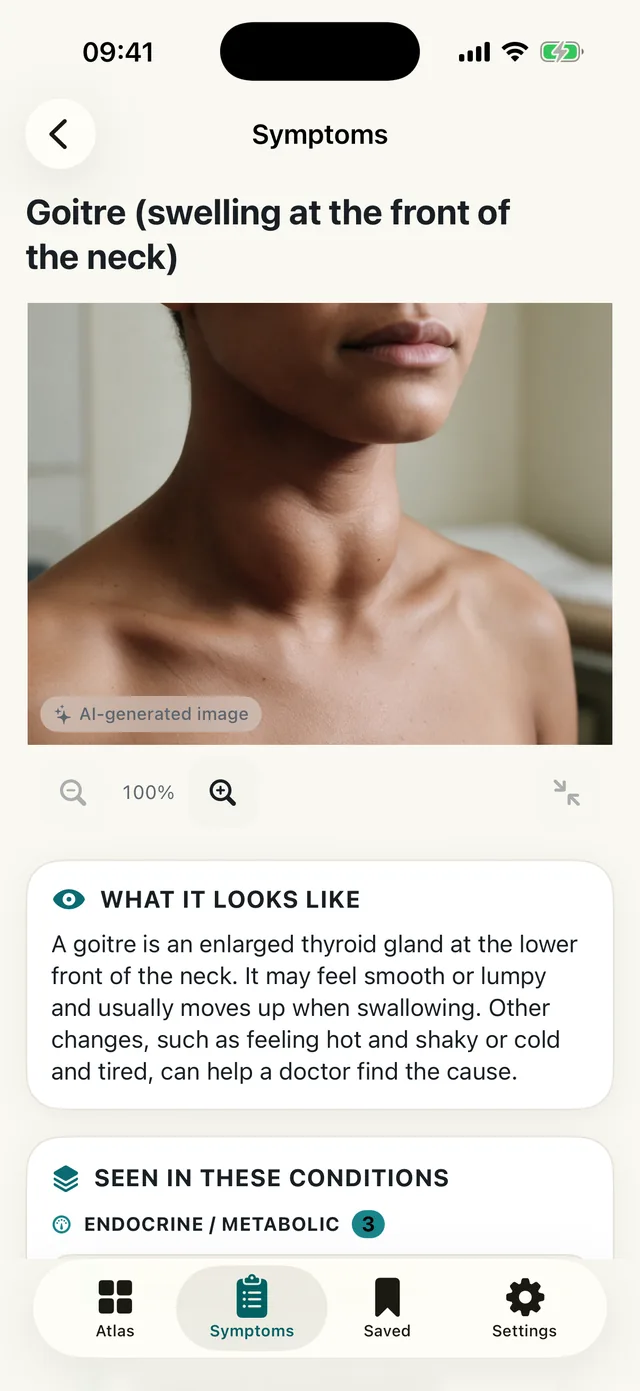
A sign, up close
A sign page shows what the sign looks like, then every condition in the atlas where it appears, grouped by specialty. The image is zoomable and, when it is photorealistic, labelled as AI-generated.
Inside the app
Atlas, Symptoms, Saved and Settings. Real screens from the current build, shown as captured.
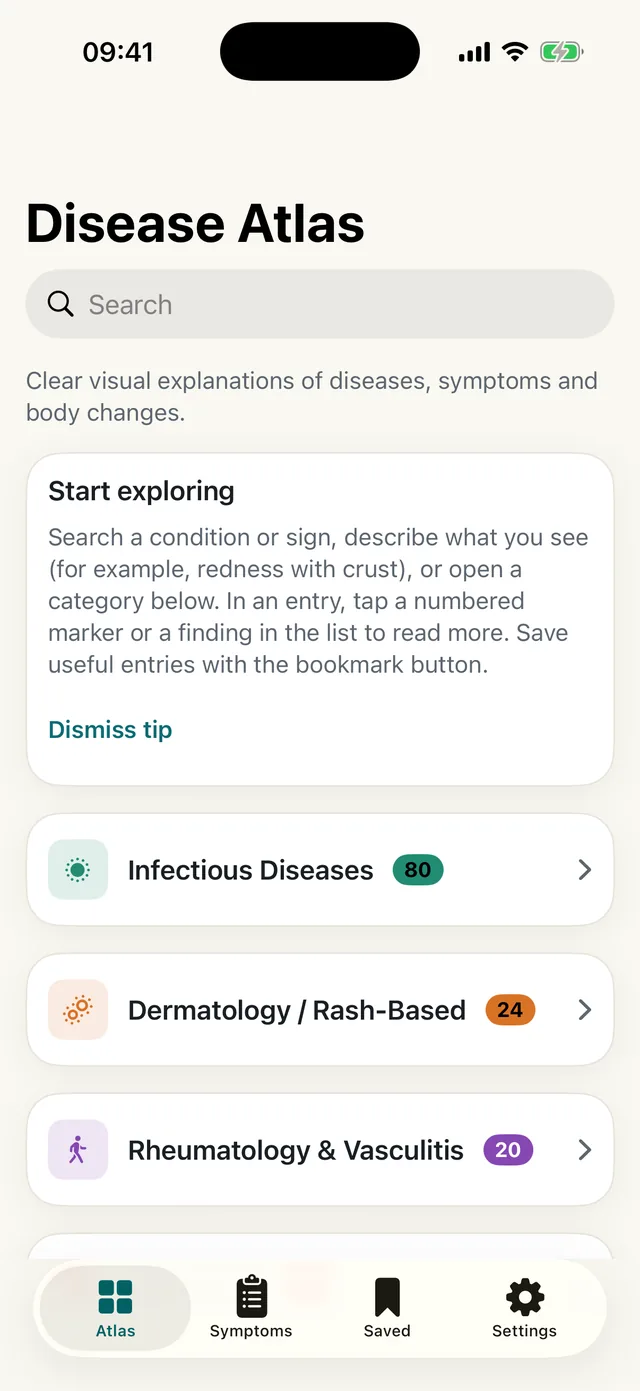
01
Search understands plain language as well as clinical terms. “redness with crust” finds the honey-coloured crust sign and impetigo; “koplik spots” finds measles. A correctly typed clinical term is never “corrected”.
Free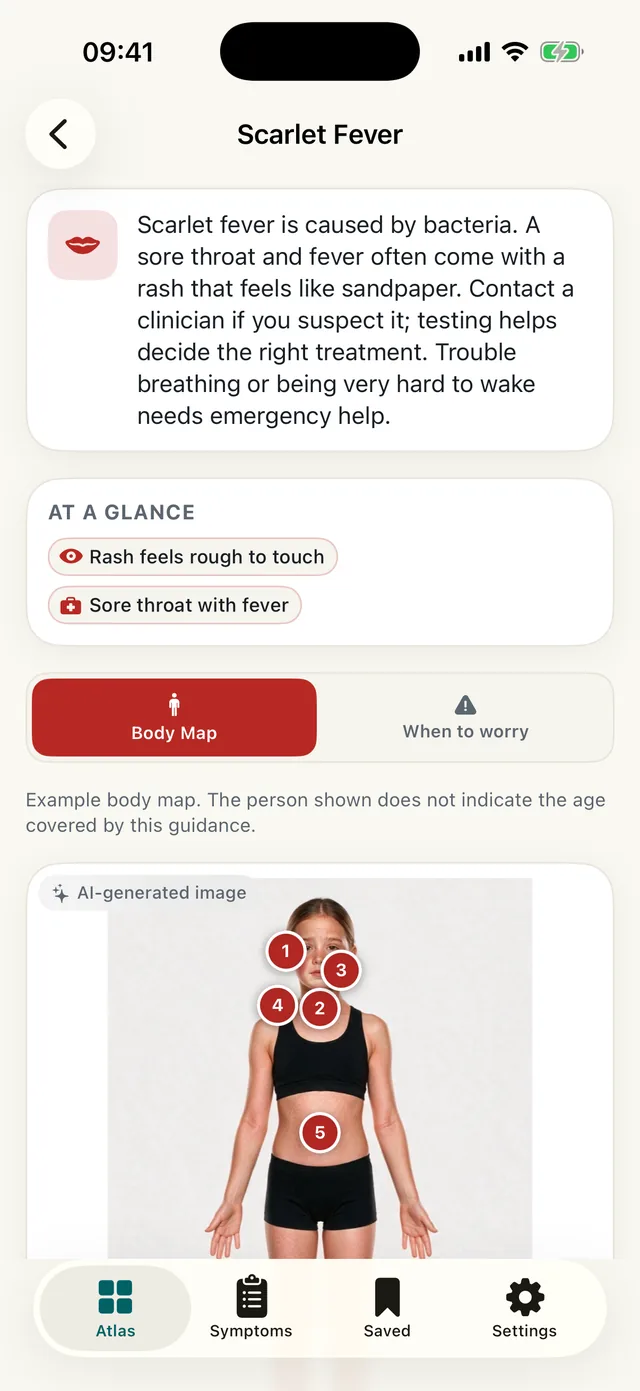
02
Then its body map and key features. In the free guide, a when-to-worry reference lists warning signs with explicit care destinations.
Free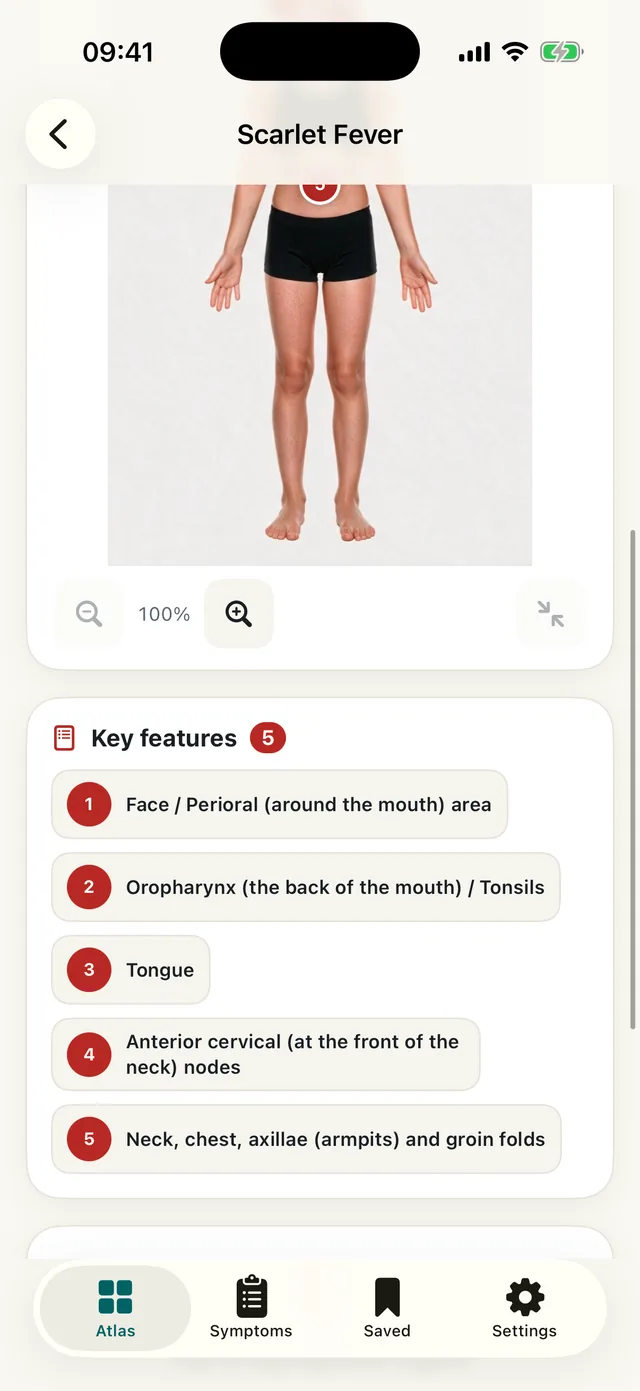
03
Tap a marker or a row to read the finding: what it looks like, why it happens, and the exam pearl. Pinch to zoom.
Free04
Grouped by body area: mouth and throat, face and eyes, hands and feet, scalp, hair and nails, the diaper and genital area, skin and rashes, and the whole body.
Free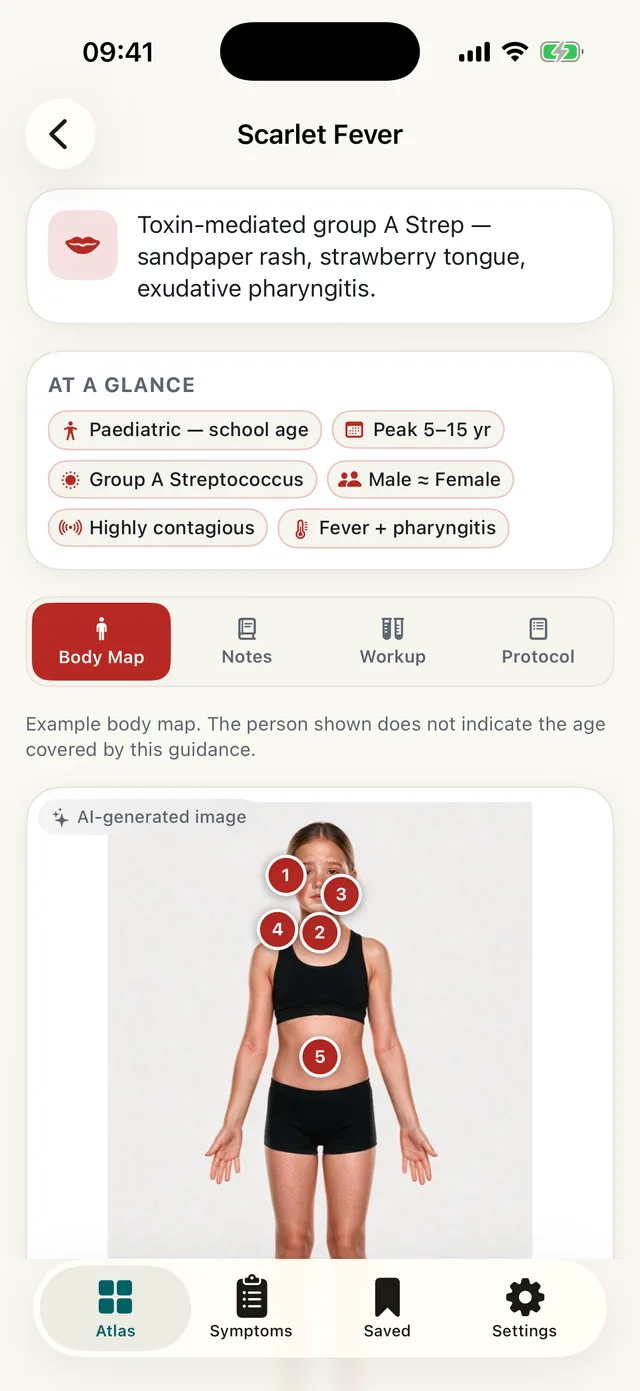
05
Clinical findings, study notes, a workup list and a management protocol for every condition, plus the AI-generated image library. The free guide stays free.
ProCapabilities
Every item below is in the current build. Image coverage varies by entry.
A better way to learn
Clinical reasoning runs along a chain: a place on the body, a sign at that place, the morphology that makes it that sign and not another, and the conditions in which it occurs. Most resources cut the chain into separate books. Disease Atlas keeps it whole, so you can travel in any direction: from a condition to its signs, from a sign to every condition that shows it, from two look-alikes to the row that separates them.
Region
Mouth & throatOne of seven body areas
Sign
Strawberry tongueOne of 80 signs
Morphology
The tongue develops a white coat pierced by swollen red papillae (white strawberry), then sheds to a beefy-red surface with prominent papillae.What it looks like
Conditions
Scarlet fever · Kawasaki disease · Toxic shock syndromeEvery atlas entry that shows it
Privacy and responsibility
No account and no sign-in. No advertising, analytics or tracking. Your bookmarks, recent entries and settings stay on the device. Pro payments go through Apple; the developer never sees your card.
Disease Atlas is an educational reference. It does not diagnose, treat or triage, and it never names a condition you or anyone else might have. Use clinical judgement and local guidance, and seek medical advice before medical decisions.
Photorealistic images are AI-generated teaching illustrations, labelled in the app. They are not photographs of diagnosed patients and can contain inaccuracies. Entries cite their sources.

Disease Atlas is being prepared for release. The Patient & family guide will be free. Disease Atlas Pro, a monthly subscription, adds the Professional version and the AI-generated image library. The launch date will be announced here.
Your email is used only to reply to you. Nothing is collected on this site.